Showing posts with label Fred Anderson. Show all posts

Wednesday, June 8, 2011

Nicole Mitchell: Awakening

Nicole Mitchell (flute)
Awakening (Delmark; 2011)
Avreeayl Ra (drums)
Jeff Parker (guitar)
Harrison Bankhead (bass)

Well, I always get a few friends who ask me about jazz flute. Unfortunately most of them are joking (e.g. Will Farrell as Ron Burgundy in the film AnchorMan), but when it comes to jazz flute there are very few out there. Yes, there are a quite a few who double as sax players. But sax is usually the main instrument and flute comes second. So it was a bit of a surprise to receive the new album Awakening (Delmark) by Nicole Mitchell. I really don't own any of her recordings but I have a number of albums she's played on (including the recent Exploding Stars Orchestra, Mike Reed, and Anthony Braxton). Even more surprising was when I told my friends about her, they already knew about her and were shocked I didn't know. Apparently I'm the one who looks like the arse now.


Over the course of the decade Mitchell has been a stalwart on the Chicago scene (as a member of the Association for the Advancement of Creative Music along with legend Fred Anderson and new trailblazer, Matana Roberts), as well as abroad. Her style is very spiritual, African and richly improvisational. Fans of the work by James Finn or John Esposito should definitely take a spin with Nicole Mitchell. Setting the tone for this project, Mitchell utilized a slightly stripped unit from her more complex larger ensembles. These groups also explored larger themes and motifs as you would expect. Awakening with its small group set up allows the quartet to experiment more with sound and space.

"Center Of The Earth" and "Momentum" both are illustrious and expansive pieces where Mitchell's flute is more like Coltrane on sax and not flute. Parker's playing is fluid and highly expressive. Bankhead and Ra keep a steady hypnotic groove that helps both tunes rotate with a real sensuality. "Momentum" contains a few lovely passages from Parker. This is another instance in which Mitchell allows her bandmates to explore structures on the own terms. At times throughout Awakening I felt as though I was listening to the Phil Ranelin era The Tribe, Doug Carn or poetic verse from 70s under-rated poet Wanda Robinson. I was thinking, it might even be nice to spin this at a party along side material from Soweto Kinch. What a way to throw a crowd straight into a history lesson, eh!?!

The quartet gets funky and humorous on "There", a solid number where Mitchell's calm playing guides the group into a rawer but subtle fusion style motifs. The title track "Awakening" closes the album in a midtempo groove with Parker and Ra having some stellar individual moments. Mitchell's playing rises above here with some strong and intense harmonic passages. When listening to Awakening you realize this group has taken a number of subtle but urgent themes and stretched them with excitement and beauty; this makes listening to Awakening a real pleasure. At the end of it all I became a fan in a matter of hours and then went back to a few of the albums I had where Mitchell performs to listen even closer to her vision. Wow. This Awakening is awesome stuff.

Wednesday, March 16, 2011

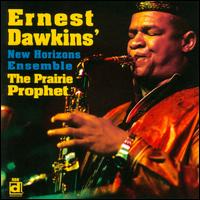
Ernest Dawkins: Why Chicago Is Important

Ernest Dawkins (sax; b. 1953)
The Prairie Prophet (Delmark Records; 2011)
Marquis Hill, Shaun Johnson (trumpet)
Junius Paul (bass)
Isaiah Spencer (drums)
Steve Berry (trombone)
Jeff Parker (guitar)

(Photo: John Broughton)

Ernest Dawkins has been a stalwart of the Chicago jazz scene for over four decades. He is the Chairman of the influential Association for the Advancement of Creative Music (AACM), which was as founded by follow sax legend, the late, Fred Anderson. Dawkins has built a solid reputation on his keen ability to blend both post bop and free jazz into something that is both accessible and adventurous all in one listen.

Ernest Dawkins expansive group, The New Horizon Ensemble shares slight similarities to follow Chicago avant-protagonist, The Art Ensemble Of Chicago. They both share unique ability to shift gears at will within a piece. While startling on first listen it becomes more clear and exciting upon the second spin. Moments of spirituality and personal empowerment bubble to the top in many of his recordings. All these aspects are on show on his new release, The Prairie Prophet.

The Prairie Prophet is dedicated to his friend, Fred Anderson and his much beloved venue, The Velvet Lounge in Chicago. The club was a bastion for free improvisation and thinking. The album opens on a gospel-tinged but political note with "Hymn To A Hip King" which is both a subtle tribute to Anderson but more a statement of great African American leaders such as Malcolm X and Martin Luther King Jr. The piece opens like a Sunday morning roll call all the while holding on to some beautiful post bop sensibilities. The performance from both Dawkins, Hill, Parker and Johnson are real emotional standouts--bristling with energy and joy.

"Sketches" delivers on that AACM heritage with uptempo rhythms and time changes and some fierce playing by Dawkins and Spencer. "Sketches" is a great example of Dawkins philosophy of playing what some may call "inside/outside"--the ability to play both accessible language built on an avant garde theme (or vice versa). "Mesopotamia" written by Steve Berry is a lovely, meditative piece that explores the range of the entire ensemble. It's a ballad with a great deal of depth and range. Berry and Spencer take the lead in the beginning with great solo work. Parker joins in later with an effective and resonant performance. Dawkins closes out the piece with a gentle and impressionist display.

The closing number "Baghdad Boogie" is a whimsical yet jumpin' number that also serves as political statement on the horror in Iraq. The ensemble displays a real craft for melodic movements within solid, bold statements. The chants, vocals and force of Dawkins sax and the intricacy of Parker, Paul here delivers a real impact for me. There have been very few musical statements in jazz about the war. "Baghdad Boogie" hearkens back to the Black Power Movement of the late '60s and '70s and the Vietnam War. A great close statement. 

The Prairie Prophet is yet another stellar and importnat document from the Chicago scene that blends the old and new guard thoughts with ease. Ernest Dawkins keeps the flame and philosophy of AACM, AEC and Fred Anderson alive with another powerful performance that while it might be label as free jazz is still thought-provoking and listenable by any music fan. Highly Recommend.

Friday, February 25, 2011

Irene Schweizer

Irene Schweizer (piano; b. 1941)
Portrait (Intakt Records; 2005)


One artist that I have been really late getting into was Swedish native, Irene Schweizer. I own a few records that she is a guest musician on but never venture into her own material. I think a lot of it had to do with my noticing how many albums she had and not knowing where to start. Then I was in a record store and randomly looking around (money burning in pocket to be spent) and I stumbled across what would turn out to be a really great compilation, entitled Portrait (Intakt Records). And I've been listening repeatedly ever since.


Irene Schweizer's style is firmly set in improvisation but she weaves between traditional and free jazz quite smoothly. There is a direct, forceful nature to the way she handles the keys but you can hear her mission is to take you to a different place altogether.


Schweizer has been compared to Cecil Taylor throughout her career but I'm starting to think that is truly unfair. Portrait covers material done with duos, trio, quartets and solo. The more interesting pieces for me are the duos. The settings are challenging and Schweizer plays and battles with the best of them (Fred Anderson, Hamid Drake, Andrew Cyrille, Louis Moholo, Hans Bennink and more).


Portrait begins with the wonderful solo piece "Sisterhood Of Spit" which feels like an Earl "Fatha" Hines or Thelonious Monk piece. It's jumpin', thoroughly intuitive and is the best evidence that she should not be compared to Mr. Taylor (not that there's anything wrong with that). The mix of collaborations and solo material on Portrait is perfectly balance and gives an excellent example of Schweizer's capabilities in various settings. "Willisau" performed with a trio including Fred Anderson (sax) and Hamid Drake (drums) is a brilliant piece of improvisation. A dueling interplay between all three musicians where each stands tall but never seem to overtake the other. Schweizer's performance is complex but with a great deal of rhythm.


Schweizer delivers a great version of Monk's "Hackensack" as a duo with drummer Han Bennink which almost feels like a tribute to New Orleans thanks to Bennink's timing. Schweizer's arrangement stays true to the original but with a little more improvising and surprisingly more buoyancy than the original (if you can believe it).


The most diverse piece on this compilation is "Come Along, Charles" recorded as the trio Les Diaboliques, featuring the magnificent Maggie Nichols (voice) and Joelle Leandre (bass). It's a short piece and only gives a brief taste of the full live performance. Schweizer's playing standouts here because of the subtly. Unlike the other settings, she allows Nichols and Leandre to take the fore. "Come Along, Charles" is a nice bit of classical avant garde.


I have a feeling a lot of you may be like me in that you didn't know where to start with Irene Schweizer's music. I have to say Portrait is a great primer and entry point. After this I would suggest any of the duo recordings. Portrait was a great find for me. I hope that you guys can find it as well. Enjoy...